
Lancaster District CVS joins landmark agreement to strengthen Lancashire and Cumbria
Lancaster District CVS has joined universities, councils, NHS organisations and education partners from across Lancashire and Cumbria in signing a landmark agreement to strengthen collaboration, tackle regional challenges and improve opportunities for local communities.
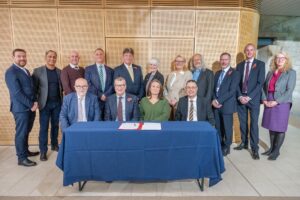 Chief Officer Yak Patel represented Lancaster District CVS at the formal signing of the Civic Universities Agreement (CUA), which brings together four universities and key civic partners in a shared commitment to improving outcomes for people and places across the region.
The agreement has been formally signed by Edge Hill University, Lancaster University, the University of Cumbria and the University of Lancashire, alongside a range of civic and public sector partners.
Other signatories include Lancashire Combined County Authority, Lancashire County Council, Westmorland & Furness Council, Blackburn with Darwen Borough Council, Blackpool Council, Lancaster City Council, Lancaster & Morecambe College, University Hospitals of Morecambe Bay NHS Foundation Trust and Lancashire and South Cumbria Integrated Commissioning Board.
Lancaster District CVS has been involved in shaping the agreement over the past two years, helping to ensure that the contribution of the voluntary, community, faith and social enterprise (VCFSE) sector is recognised within this wider regional partnership.
The agreement acknowledges that many of the opportunities and challenges facing communities cannot be addressed by individual organisations working alone. It provides a framework for universities, public services and the VCFSE sector to combine their knowledge, resources and expertise to bring about lasting improvements for local people.
 For Lancaster District CVS, the agreement represents an important opportunity to strengthen the relationship between academic institutions and the communities they serve, ensuring that local knowledge, lived experience and the work of voluntary organisations help inform future priorities and investment.
Universities bring considerable research expertise, influence and resources that can help address some of the region’s most pressing challenges. Equally, voluntary and community organisations have trusted relationships, a deep understanding of local needs and practical experience of delivering change within communities.
Bringing these strengths together is central to the ambitions of the agreement.
In a joint statement, the four university Vice Chancellors said:
“The Civic Universities Agreement is a demonstration of our commitment to work collaboratively for the benefit of our communities and take a longer-term, strategic approach across Lancashire and Cumbria.
“This milestone moment is the result of careful debate and deliberation over three years.
“Together, we will harness our knowledge and talent to enable our rural, coastal and urban places to prosper and flourish.
“Our universities are rooted in our local area. This agreement will strengthen our ability to work with partners to create opportunities, support inclusive economic growth and transform the lives and livelihoods of people across Lancashire and Cumbria, both now and for future generations.
“As anchor institutions, we have an important role to play in using our education, research and partnerships to make a lasting difference in our communities.”
Shared priorities for Lancashire and Cumbria
Six priority themes have been identified as part of the Civic Universities Agreement.
These include creating connected communities, driving economic growth, developing a skilled workforce, reducing health and social inequalities, and supporting environmental sustainability.
Another key commitment is to strengthen the area’s collective identity through a stronger shared narrative, helping to attract greater investment into Lancashire and Cumbria from government and through collaborative research opportunities.
These priorities closely reflect many of the issues facing voluntary and community organisations across Lancaster District, particularly around health inequalities, community resilience, skills development and ensuring that opportunities reach those who need them most.
County Councillor Brian Moore, cabinet member for Economic Development and Growth at Lancashire County Council, said:
“This Civic Agreement recognises the valuable role universities play in the communities they serve. The commitment to work together to secure investment, address challenges such as skills gaps and create new opportunities for our communities is very welcome.
“I look forward to building on the strong partnerships emerging from this agreement to grow our local economy and make Lancashire and Cumbria even more attractive places to live, work and invest.”
Building on established partnerships
The four universities have a long history of working together on projects for the benefit of the North West.
Their collaboration has helped attract major government investment in initiatives such as the National Cyber Force and Eden Project Morecambe, build educational capacity in Barrow Learning Quarter, and secure competitive research and innovation funding to support regional economic growth.
A Civic Universities Group was established in 2023 to coordinate the universities’ engagement with new pan-regional initiatives, including devolution, the Lancashire Growth Plan, Cumbria’s Economic Strategy and significant national investment in defence and national security infrastructure.
The Civic Universities Agreement now provides a framework to align, strengthen and enhance this existing work while identifying opportunities for new initiatives.
Cllr Jonathan Brook, Leader of Westmorland and Furness Council, said:
“Our local universities already play an important role in shaping the culture, society and economy of Lancashire and Cumbria. This agreement represents another step on our journey of collaboration that has already brought real benefits to the area.
“Lancashire and Cumbria are unique and remarkable places, with strong communities and a proud history. However, they also face some significant and complex challenges that it is very difficult for any individual organisation to address alone. The Civic Universities Agreement represents a fantastic opportunity to work together as civic partners alongside the 4 universities to innovate, develop new opportunities, solutions and partnerships to address challenges and bring real benefits to our communities and local places.”
Initial projects include developing the Lancashire Data Observatory and producing a roadmap for universities to work with further education providers and combined authorities to address skills gaps.
Councillor Phil Riley, Leader of Blackburn with Darwen Council, said:
“We are rightly proud of the quality of universities that are on our doorstep. We know that a lot of our young people choose to stay local for their further education and we want to keep that talent to help our places prosper.
“Having access to the research and expertise at all of these universities is invaluable. This is brilliant timing as we move to having a Mayoral Strategic Authority in Lancashire.”
Cllr Lynn Williams, Leader of Blackpool Council and Chair of the CCA’s Economic Advisory Board, added:
“Our world established universities are part of what makes Lancashire great. They aren’t just about training people up with degrees and skills, but they are large economic drivers for our county. As well as bringing students from all over the world, their research arms bring in international investment and are deeply embedded in helping our best local businesses to grow, innovate and create jobs. This is another really positive step forward for Lancashire, as we create a shared narrative around living and investing in our red rose county.”
Ensuring communities remain at the heart of the agreement
For Lancaster District CVS, an important aspect of the agreement will be ensuring that the VCFSE sector has meaningful opportunities to contribute as the partnership develops.
The organisation looks forward to supporting connections between communities, universities and public services, particularly where research, learning, volunteering and innovation can help address local needs and attract investment that benefits residents.
The agreement also offers opportunities to build on existing relationships across Lancaster District, recognising the important role that smaller voluntary and community organisations play in understanding local challenges and developing practical solutions.
Progress against the agreement’s objectives will be reviewed annually, with a steering board providing strategic oversight and a delivery group responsible for developing and implementing projects.
Lancaster District CVS welcomes the commitment to sustained collaboration and looks forward to working with fellow signatories to ensure that the knowledge, experience and strengths of local communities contribute to the agreement’s long-term ambitions.
Read the Civic Universities Agreement
Notes for editors
In 2024/25, the four universities employed more than 10,000 staff, spent £122 million on capital programmes and educated a combined student population of over 60,000 based in Lancashire and Cumbria.
