
Trustee Week 2026
To celebrate Trustees’ Week 2026, we’re shining a spotlight on the people who help guide and support Lancaster District CVS. Our trustees bring a wealth of experience, knowledge and different perspectives to the organisation, generously giving their time to help us continue supporting voluntary, community, faith and social enterprise organisations across the Lancaster District.
But who are the people behind the boardroom decisions, and what inspired them to become trustees? We’ve been asking our trustees a few questions to find out more about their backgrounds, what they enjoy about the role, what has surprised them and why they’d encourage others to consider trusteeship. Through their stories, we hope to offer a glimpse into what being a trustee is really like and perhaps inspire a few more people to get involved!
Anthony Murray | LDCVS Trustee

What do you do when you’re not being a trustee? What’s your professional background?
I work in social care, helping to develop and run services across Lancaster and Morecambe that support people to live independently and make the most of their lives.
Why and how did you become a trustee with Lancaster District CVS?
In one way or another, I’ve been involved in community groups since I started hospital radio aged 13, so becoming a trustee at LDCVS felt like a great opportunity to support the people and organisations making a real difference in our communities.
What do you enjoy most about being a trustee?
I really enjoy hearing all the different stories and seeing the many ways people come together to tackle problems and make things better where they live.
Can you name one thing that surprised you about being a trustee?
I was a little worried that sitting on a board might be overly formal and official, but actually it’s really great coming together with people and hearing from the team doing all the hard work and being able to offer a different perspective or just be a sounding board for them.
Why do you think other people should consider being a trustee?
There’s hundreds of organisations right on our doorsteps doing fantastic things, and the more people who get involved, the bigger the difference we can make. You don’t need to be an expert or have lots of spare time; sometimes even an hour a month, a fresh perspective and a willingness to help can make a real difference.
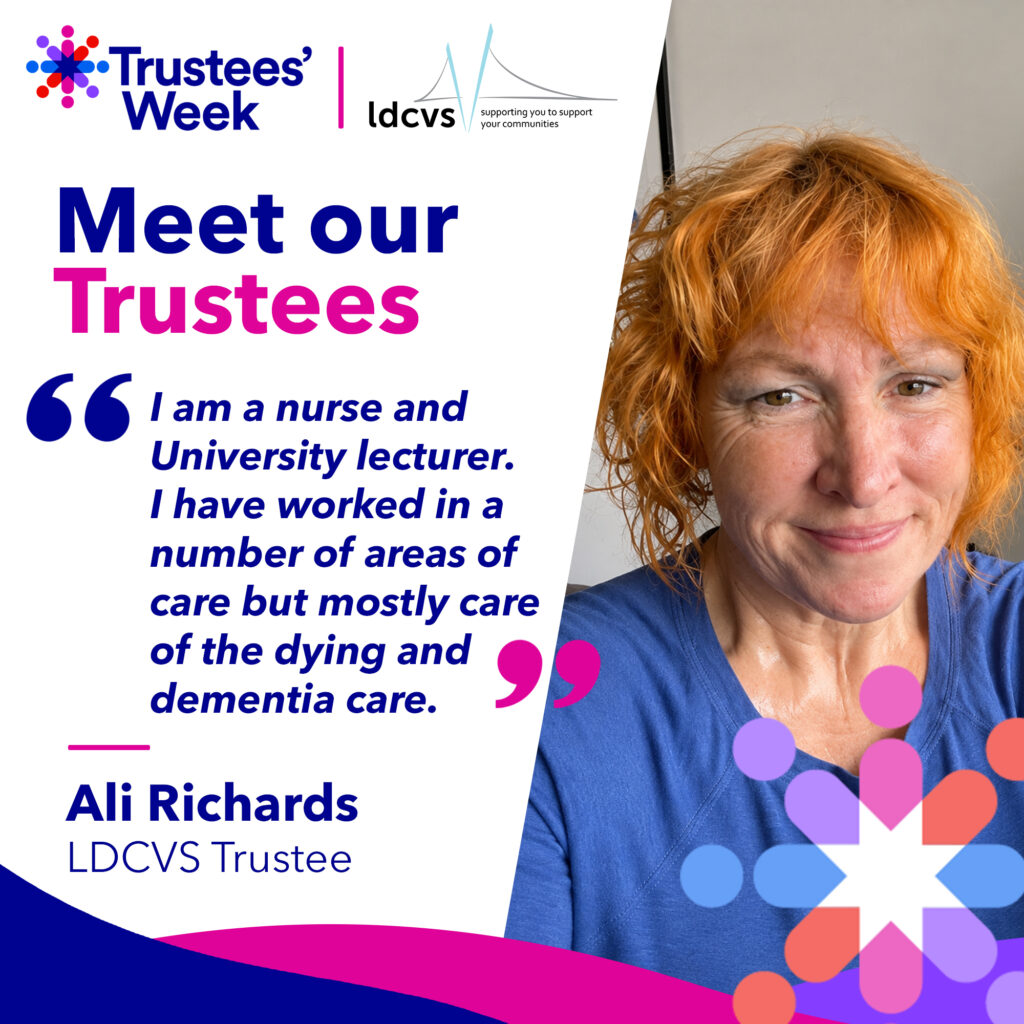
Ali Richards | LDCVS Trustee
What do you do when you’re not being a trustee? What’s your professional background?
I am a nurse and University lecturer. I have worked in a number of areas of care but mostly care of the dying and dementia care.
Why and how did you become a trustee with Lancaster District CVS?
Eek I cant remember is it 3 years? Also it was through Paul who is a friend of mine and he suggested it to me.
What do you enjoy most about being a trustee?
I really enjoyed the volunteers evening last year. It gave me such a sense of pride in our community and a sense of hope about the really excellent work that is being done to improve communities. In addition I think hearing about everything and meeting the other trustees inspires me to believe in the good people can do if they work together for others.
Can you name one thing that surprised you about being a trustee?
I was surprised by how much people are doing in Morecambe to improve the community and how much people care about each other. The news often tells us another story but its really inspiring as well as surprising. I also find the team at CVS so good and really strong especially Yak.
Why do you think other people should consider being a trustee?
It is both uplifting and challenging to be a trustee. It renews a sense of goodness and community but also involves meeting some brilliant people and starting to connect with the communities we live among
Ali Richards | LDCVS Trustee

What do you do when you’re not being a trustee? What’s your professional background?
I’m a nurse and work across Lancashire & South Cumbria, my work focuses on patient experience, engagement and safeguarding
Why and how did you become a trustee with Lancaster District CVS?
I have volunteered in roles since I was 14 and really see volunteers as heroes across communities, the work of LDCVS really encourages this and empowers people to make a difference in their communities, a simple application process and meeting key people enabled me to apply and agree to take up a trustee role, then I became chair of the board and work closely with Yak to really drive the LDCVS work forward
What do you enjoy most about being a trustee?
Being a trustee is totally different to my day job, decision making is easier and more focused on local people and you get immediate feedback on the impact of changes and services provided
Can you name one thing that surprised you about being a trustee?
How attached you become to a charity, and you really want to ensure a difference is made in a speedy way as well as the breadth of services that charities do to support people
Why do you think other people should consider being a trustee?
Being a trustee really adds to your skills of leadership, governance, finance and service delivery. These areas are challenges to charities and the limited funding and staff that are available – but will support you in your own life and career
Hazel Taylor | LDCVS Trustee

1 What do you do When not being a Trustee, What is your professional background?
I was an NHS Manager working mainly with clinical staff on service redesign and commissioning new services. This included the development of Targeted Lung Cancer Screening in West Yorkshire and locally supporting clinical staff at University Hospitals Morecambe Bay to develop one stop pathways in gynaecology and a business case for equipment that would save children from having to travel to Alder Hay Hospital for follow up heart scanning. I worked closely with GP Practices and Cancer Services, but also supported the development of new governance structures to meet NHS England requirements during a major NHS reorganisation.
I am now retired and enjoy walking my dog. I also volunteer for the Box Office at The Heron Theatre in Beetham. I have two grandchildren who I take to after school activities three times a week.
2. Why and How did you Become a Trustee with Lancaster District CVS?
After I retired, I wanted to continue to use the skills I gained during my working life. I initially contacted an organisation supporting the recruitment of School Governors and after their assessment process they suggested I could look at Trustee opportunities. I really wanted to stay local and saw an advert on Linked In for Trustees for LDCVS. I attended a couple of Board Meetings as an observer prior to being confirmed as a Trustee
3. What do you Enjoy about being a Trustee?
Learning more about my local communities and all the charities supporting people in need. Seeing how LDCVS offers support, through the events they run and services they provide, especially support to find suitable funding opportunities.
4. Can you Name one Thing that Surprised you about being a Trustee?
The number of local charities supporting communities and the variety of funding grants that are available.
5. Why do you think other people should consider being a Trustee?
It is a way to become more connected to local communities. Local charities are often started by people with a passion for their community, but they need the support that others can provide in helping them realise their vision. Support can be of different skills, finance, marketing, Digital and compliance with national charity governance. But sometimes it is having others to discuss ideas and share the burden of managing an organisation.
Jess Shaw | LDCVS Trustee

What do you do when you’re not being a trustee? What’s your professional background?
I work full time at Lancaster University, supporting researchers to engage with communities outside of the university and the general public. I also run creative workshops with young people and communities that are about connecting with nature, and advocate for the protection of swifts in my local area. Prior to this I used to work at a science museum in Bradford, running events and supporting people from all different backgrounds to get involved with science. I love being outside: I’m a wildlife photographer, I go walking and hiking as often as I can with my lovely partner and we love going camping year-round. He has a motorbike so we’re often loading it up and going off on adventures on it. I like learning new things and at the moment I’m learning to make scalemail and chainmail armour.
Why and how did you become a trustee with Lancaster District CVS?
I wanted to become a trustee to contribute to the local community, and because I believe that the work CVS is doing is incredible, and I thought I would also gain a lot from being a trustee.
What do you enjoy most about being a trustee?
What I’m enjoying the most is building relationships with people who work and volunteer in the local area and increasing my understanding of how the organisation works.
Why do you think other people should consider being a trustee?
Being a trustee is a great way to develop your skills and knowledge, meet new people, and contribute your experience to an organisation you believe in, so that they can continue doing good things in the community, and it works around your other commitments – I’d definitely recommend it to anyone who’s wanting to do something new and feel like they’re making a difference.
Trustee Short Profile
1 What do you do When not being a Trustee, What is your professional background?
I was an NHS Manager working mainly with clinical staff on service redesign and commissioning new services. This included the development of Targeted Lung Cancer Screening in West Yorkshire and locally supporting clinical staff at University Hospitals Morecambe Bay to develop one stop pathways in gynaecology and a business case for equipment that would save children from having to travel to Alder Hay Hospital for follow up heart scanning. I worked closely with GP Practices and Cancer Services, but also supported the development of new governance structures to meet NHS England requirements during a major NHS reorganisation.
I am now retired and enjoy walking my dog. I also volunteer for the Box Office at The Heron Theatre in Beetham. I have two grandchildren who I take to after school activities three times a week.
2. Why and How did you Become a Trustee with Lancaster District CVS?
After I retired, I wanted to continue to use the skills I gained during my working life. I initially contacted an organisation supporting the recruitment of School Governors and after their assessment process they suggested I could look at Trustee opportunities. I really wanted to stay local and saw an advert on Linked In for Trustees for LDCVS. I attended a couple of Board Meetings as an observer prior to being confirmed as a Trustee
3. What do you Enjoy about being a Trustee?
Learning more about my local communities and all the charities supporting people in need. Seeing how LDCVS offers support, through the events they run and services they provide, especially support to find suitable funding opportunities.
4. Can you Name one Thing that Surprised you about being a Trustee?
The number of local charities supporting communities and the variety of funding grants that are available.
5. Why do you think other people should consider being a Trustee?
It is a way to become more connected to local communities. Local charities are often started by people with a passion for their community, but they need the support that others can provide in helping them realise their vision. Support can be of different skills, finance, marketing, Digital and compliance with national charity governance. But sometimes it is having others to discuss ideas and share the burden of managing an organisation.
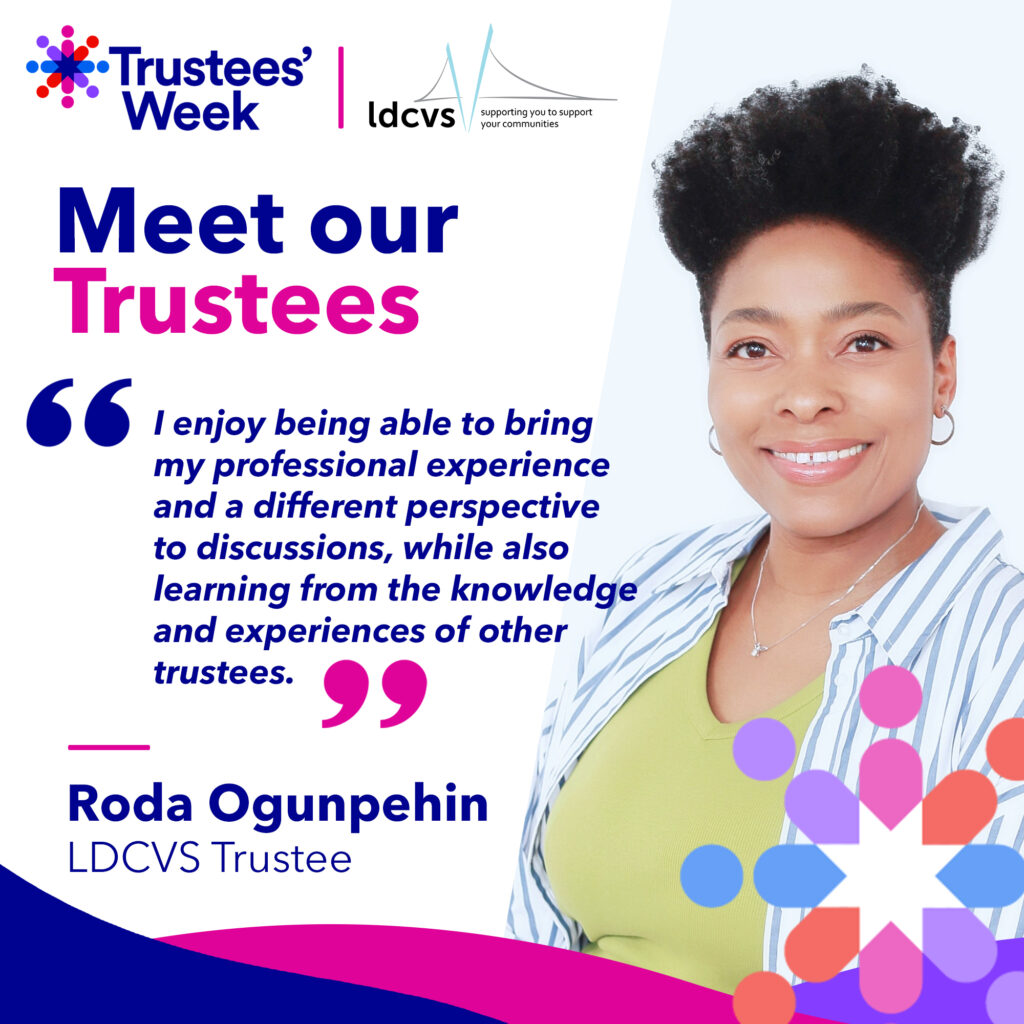
Roda Ogunpehin | LDCVS Trustee
1. What do you do when you’re not being a trustee? What’s your professional background?
I’m the founder of RQ Consult, where I work with organisations on equality, diversity and inclusion, helping them to build more inclusive and equitable workplaces. My professional background includes working in social housing and the Civil Service, where I held diversity and inclusion leadership roles. I’m also the author of Not Too Small for Inclusion.
2. Why and how did you become a trustee with Lancaster District CVS?
Having previously held trustee roles, I understand the value that good governance and diverse perspectives bring to an organisation. I was interested in contributing my experience and skills to an organisation with a strong connection to local communities and the voluntary sector. Lancaster District CVS offered an opportunity to continue making a contribution in an area that I care about.
3. What do you enjoy most about being a trustee?
I enjoy being able to bring my professional experience and a different perspective to discussions, while also learning from the knowledge and experiences of other trustees. I particularly value being able to contribute to decisions that have a wider impact on the organisation and the communities it supports.
4. Can you name one thing that surprised you about being a trustee?
How much the role requires you to step back from the day-to-day and think about the bigger picture. It’s about asking the right questions, providing constructive challenge and making sure decisions are in the best interests of the organisation and the people it serves.
5. Why do you think other people should consider being a trustee?
Trusteeship is a valuable way to use your skills, knowledge and life experience to make a difference. You don’t have to come from a traditional board or business background. Different perspectives, experiences and voices are important in good governance. It’s also an opportunity to learn, develop and contribute to something that has a wider purpose.
Trustee Myth Busting
Have you ever considered becoming a trustee but been put off by your ideas about what being a trustee means? Or perhaps you’ve never considered it, for the same sorts of reasons? Here we look at some common myths about being a trustee that many people believe and which can prevent someone from trying to become a trustee.
#1 MYTH: To be a trustee you should be older
Not true! Anyone from the age of 18 can be a trustee and there is no upper age limit. Trustees do tend to be older – in fact the average age of a trustee in the UK is 65, with over half of them being retired – but it isn’t a rule. So if you are younger and want to be a trustee, your age should not stop you!
#2 MYTH: I can’t be a trustee because I have a full time job and won’t have time
Not true! Many trustee roles require just a few hours of your time per month. Many boards meet quarterly, or perhaps up to 6 meetings per year. And these days many meetings are either entirely online or a hybrid, allowing people to turn up in person if they can or join via videocall if they can’t. And often trustees will meet in the evenings, outside of working
hours.
#3 MYTH: It’s boring!
Boring is subjective of course, but being a trustee is an opportunity for you to get involved in something that you are really passionate about, whether that’s the cause of the organisation itself, or a specific role within the organisation, such as fundraising, marketing and promotion, or something else. Being on the inside and seeing how everything works, not to mention witnessing first hand just what a difference you are making, is never boring!
#4 MYTH: I’m not important/experienced enough to be a trustee
Many people think that to be a trustee for an organisation you need to have, or have had, a big, important position in your working life – solicitor, doctor, bank manager! But trustee boards work best when there are a variety of voices represented on them and everyone’s voice brings value because everyone’s own experience is different. You don’t even need any particular qualifications to be a trustee. Whatever your background, whatever your experience, whatever your skills or your qualifications, you WILL bring value and you ARE important!
#5 MYTH: If things go wrong, I will be personally liable!
No! Trustee liability is usually limited to £1. If you are a trustee for an organisation and it goes bust, you won’t lose anything.
#6 MYTH: Being a trustee is by invitation only
Trustee boards will regularly advertise for new trustees, and many boards will even welcome direct approaches from people interested in joining. Sometimes a board will look to “co-opt” a trustee, perhaps because they need a particular expertise or skill, so they might seek people out and ask if they would be willing to help out, but as a general rule trustee roles are advertised just like any other volunteer role.
#7 MYTH: Trustees are paid
Trustees are volunteers and as such they are not paid. Like any other volunteers they may be able to claim reasonable expenses, such as for travel to meetings, but they are not paid a salary or a stipend. If something here has changed your mind, or made you think again about trusteeship, and you want to find out more about which local groups need new trustees, contact us.
Trusteeship by Numbers (Statistics from data reported in 2025)
- There are over 2 million people in the UK who serve as trustees
- The average age of a trustee is 64 years old
- Over half of trustees are retired
- Less than 0.5% of UK trustees are under 24 – we’d like to change that!
- 57% of trustees are men
- Only 8% of trustees are from minority ethnic backgrounds – we’d like to change that too!
- 50% of current trustees are first tie trustees!
- 57% of trustees come from professional backgrounds
- 74% of trustees sit on boards that have between 4 and 10 board members
- Only 6% of trustees find their role through formal advertisements – another thing we’d like to change!
- 28% of trustees serve on boards for organisations with an annual income of under £10,000
Interested in becoming a Trustee?
Perhaps you’ve thought about becoming a trustee but weren’t quite sure what the role involves, or maybe it’s something you’ve never considered before. Whatever your experience or background, trusteeship could be an opportunity to use your skills, share your perspective and make a real difference to a cause you care about.
Find out more about becoming a trustee and how to get involved.
